Changes the currency used to display prices on this site.
0 Cart
Added to Cart
    You have items in your cart
    You have 1 item in your cart
    Total
    Check Out Continue Shopping

    Info & Tips

    Zamboni: The Coolest Ice Invention with the Very Funny Name Explained

    zamboni

    You might have seen a funny-looking machine smoothing the ice at a hockey rink or skating arena.

    That machine is called a Zamboni, and despite its playful name, it has changed how ice surfaces are kept perfect.

    The Zamboni is the ice resurfacer invented by Frank Zamboni that quickly cleans, smooths, and refreezes ice, making skating safer and more enjoyable for everyone.

    This invention didn’t come out of nowhere.

    Frank Zamboni used his skills in refrigeration and mechanics to solve a real problem: how to maintain a large ice rink without wasting time or effort.


    ENJOY A SMOOTH SKATING EXPERIENCE WITH A SURFACE THAT OFFERS OPTIMAL GLIDE AND PERFORMANCE WITH POLYGLIDE ICE


    Since its creation in the late 1940s, the Zamboni has become a key part of ice sports around the world.

    If you want to understand why the Zamboni is so important and how it got its unusual name, you’re about to learn the story behind this cool invention.

    It’s not just a machine, but a clever tool that changed the game for hockey players and skaters everywhere. 

    Learn more about Frank Zamboni’s legacy and invention at The History of the Zamboni.

    cool zamboni

    What Is a Zamboni and Why Is It So Cool?

    A Zamboni is a special machine designed to smooth out the surface of ice rinks quickly and efficiently.

    It solves a big problem by doing in minutes what used to take several people over an hour. 

    You’ll see it at hockey games, ice shows, and skating rinks, where its work keeps the ice safe and fun to skate on.

    Purpose of an Ice Resurfacer

    An ice resurfacer’s main job is to clean and smooth the ice.

    Over time, skaters create grooves and rough patches on the ice, which can make it unsafe and slow.

    The machine shaves off the top rough layer, collects the snow, and lays down a thin layer of warm water to freeze into a fresh, smooth surface.

    This process takes only about 10 to 15 minutes with a Zamboni, compared to up to 90 minutes by hand.

    The speed and efficiency mean less downtime for rink users and a better skating experience overall.

    Defining Features of a Zamboni

    A Zamboni is more than just an ice resurfacing machine; it has specific parts that work together for the job. It has a sharp blade underneath that shaves the ice.

    Then, an auger moves the shaved ice (or snow) into a storage tank.

    The machine sprays warm water to fill in gaps and freeze smooth.

    Key parts include:

    • Shaving blade
    • Horizontal auger
    • Snow collection tank
    • Water distributor

    The design has improved since its invention in 1949 but still follows the same basic process.

    Every Zamboni is made with custom parts built to handle cold, wet environments and last for many years.

    The Zamboni Name and Its Popularity

    The Zamboni machine is named after its inventor, Frank Zamboni.

    Originally, the company was called Paramount Engineering, but the inventor’s last name became famous worldwide.

    The name “Zamboni” is now often used for any ice resurfacer, even those not made by the Zamboni company.

    Its unique name and the machine’s slow, steady movement during breaks at hockey games have made it a cultural icon.

    People often watch the Zamboni just for fun, waving or cheering.

    Unlike other machines, the Zamboni has a personality that’s helped it become a well-known symbol in hockey and skating. 

    You’ll find Zambonis at most NHL arenas and ice rinks around the world.

    For detailed history and how the machine works, check this article on the history of the Zamboni.

    origins of zamboni

    The Origins of Zamboni: A Very Funny Name

    The name “Zamboni” might sound unusual or funny at first, but it has a clear origin tied to the man who invented the ice resurfacing machine.

    Understanding the meaning behind the name and how it became a powerful brand can help you appreciate its unique place in ice sports.

    The Meaning Behind the Name

    The name Zamboni comes from Frank J. Zamboni, the inventor and founder of the company that created the ice resurfacing machine.

    Frank was an engineer who owned an ice rink in Paramount, California.

    After years of work, he invented a machine in 1949 that greatly improved how ice rinks were maintained.

    The word "Zamboni" is simply Frank’s last name and doesn’t have a meaning beyond that. It’s not an Italian word or slang, just his family name.

    Over time, the machine itself became so well-known that "Zamboni" became the common term for any ice resurfacer.

    This makes the name memorable and tied directly to its inventor’s legacy.

    Trademark and Brand Recognition

    The Zamboni name is not just a last name; it's a registered trademark owned by the Zamboni Company, founded by Frank J. Zamboni & Co.

    This trademark protects the brand and helps the company maintain its reputation as the leader in ice resurfacing technology.

    Because of this strong brand recognition, many people use “Zamboni” to describe all ice resurfacers, even if they are made by other companies.

    The Zamboni Company’s focus on innovation and quality has kept it closely linked to the sport of hockey and ice skating worldwide.

    The patent for the original machine was first granted in 1953.

    Since then, the company has developed many models, but the Zamboni name continues to stand out as the top brand in this market.

    frank zamboni

    Frank Zamboni: The Inventor Who Changed Ice Forever

    You can trace the success of the Zamboni ice resurfacing machine back to Frank Zamboni’s unique background and drive to solve real problems.

    His early skills, business moves, and insistence on innovation shaped the tool you now see at almost every ice rink.

    Early Life and Background

    Frank Joseph Zamboni was born on January 16, 1901, in Eureka, Utah.

    His family soon moved to a farm in Idaho where he learned mechanical skills by fixing and building things on the farm.

    His hands-on experience with machines gave him a practical understanding of how things worked.

    You should know Frank only completed education up to the ninth grade.

    Despite limited formal schooling, he had a natural talent for engineering and problem-solving. 

    This skill set was important later, as it helped him design effective and durable machines with simple principles.

    From Refrigeration to Ice Rinks

    Originally, Frank and his brother Lawrence ran an electric service shop.

    They then built an ice plant that made large ice blocks to meet local demand before widespread refrigeration.

    But as refrigeration technology improved in the late 1920s, demand for these ice blocks dropped.

    Seeing this change, Frank and his brother turned toward ice rinks.

    They opened the Paramount Iceland rink in 1940 using their chill tech, but resurfacing ice by hand was slow and labor-heavy.

    You can understand how this problem pushed Frank to think of a better way.

    The Drive to Innovate

    Frank took over managing the rink and worked on improving ice maintenance.

    After many tests, he built the first Zamboni Model A in 1949 using parts from surplus World War II vehicles.

    The machine shaved thin layers of ice, collected the shavings, and laid down fresh hot water...

    ...all in one pass!

    He kept improving the design, making it easier to use and more efficient.

    This drive led to the creation of one-person operated models that saved time and labor in ice care.

    His invention turned ice resurfacing into a quicker, better, and more affordable process, changing ice sports forever.

    Learn more about Frank Zamboni’s story with Frank Zamboni - Wikipedia.

    the evolution of th eice resurfacer

    The Evolution of the Ice Resurfacer

    The ice resurfacer started as a slow, hard task and became a fast machine that changed ice rinks everywhere.

    Over time, improvements like better engines and design upgrades made the Zamboni ice resurfacer more effective and easier to use.

    Manual Ice Resurfacing Days

    Before machines, resurfacing ice was a slow process.

    Workers used scrapers to shave the ice by hand.

    Then several people had to scoop up the shaved ice and spread water to smooth the surface.

    This took over an hour each time. It was hard work and often interrupted activities at the rink.

    You had to wait for the water to freeze before skating could continue.

    Many ice rinks had to schedule long breaks because the process was not efficient.

    These manual methods limited how often the ice could be resurfaced and sometimes left the surface uneven.

    Model A and Jeep Engine Innovations

    The first successful ice resurfacing machine was the Model A, invented by Frank J. Zamboni in 1949.

    This model combined parts from old vehicles, including a Jeep engine, to power the machine.

    It made resurfacing faster and less labor-intensive.

    The Model A could shave ice, remove shavings, and add a fresh layer of water in one pass.

    You could now resurface ice in about 15 minutes instead of an hour. Using a Jeep engine gave enough power and reliability for working on large rinks.

    This was a big change from manual work.

    The Model A started a new era for ice maintenance, allowing for regular ice resurfacing during events and practices.

    You got a smoother, safer skating surface faster.

    Major Milestones in Zamboni Design

    Since the Model A, Zamboni machines have seen many upgrades.

    These include improvements in ice washing, more efficient blades, and better water tanks.

    Newer models added enclosed cabs for operators and electric or propane engines.

    One key milestone was adding an ice washing system, which improved the quality of the ice surface by cleaning it before resurfacing.

    The Zamboni Company even restored early models like the Model C to show how the machine evolved.

    Today, ice resurfacers are safer, quieter, and more environmentally friendly.

    They help you maintain ice rinks with speed and precision impossible in the past.

    The Zamboni remains a symbol of smart innovation in sports equipment.

    Learn more about the evolution of the Zamboni machine at this detailed evolution document.

    ice shavings

    How a Zamboni Machine Works

    A Zamboni machine cleans and smooths the ice by shaving the old surface, removing the ice shavings, and then laying down a fresh layer of water.

    It uses several parts that work together to make the ice flat and safe for skating or hockey.

    Shaving and Collecting Ice Shavings

    First, the Zamboni uses a sharp blade to shave the top layer of ice.

    This blade scrapes off any rough spots and cuts away tiny ridges.

    The ice shavings created by this process fall under the machine.

    Next, two augers, which are screw-shaped blades, collect and push the ice shavings to the side.

    A conveyor belt then lifts the shavings and deposits them into a snow tank on the machine.

    This system clears the loose ice pieces from the surface, so your ice rink is free from bumps and cracks.

    Applying Hot Water for a Perfect Sheet

    After shaving, the Zamboni sprays hot water on the cleaned ice.

    The water is heated inside the machine, which helps it spread evenly and melt slightly to fill in any small holes or gaps.

    This layer of water freezes faster and bonds better to the ice underneath.

    It creates a smooth, glossy surface that makes skating easier and safer.

    The machine uses a towel or blade behind the water sprayer to spread the water evenly across the surface.

    Snow Tanks and Water Systems

    The snow tank stores all the collected ice shavings until you empty it.

    This tank keeps the rink clean during resurfacing without dropping extra debris on the ice.

    The Zamboni also has a water system with pipes that deliver both wash water and ice-making water.

    Wash water cleans the ice surface before resurfacing, while ice-making water is applied after shaving.

    The water goes through pipes and is spread carefully behind the conditioner to produce fresh, smooth ice.

    These parts work together so you get a high-quality skating surface every time you use the ice resurfacer.

    For more about how the Zamboni spreads water and collects shavings, see How It Works | Zamboni.

    ice sports

    Zamboni and the Rise of Ice Sports

    The Zamboni machine changed how ice surfaces are maintained across sports.

    It made ice smoother, faster to clean, and safer for players and skaters. 

    This invention helped improve the quality of ice hockey, figure skating, and many professional competitions.

    Impact on Ice Hockey

    When you watch ice hockey, smooth ice is key. Before the Zamboni, ice was rough and uneven.

    Cleaning the ice took over an hour. 

    The old process used shovels, brooms, and hand tools, making the surface bumpy.

    This caused pucks to bounce strangely and players to lose balance.

    The Zamboni cut ice cleaning time to minutes.

    It shaves the ice, collects shavings, and spreads a thin layer of water that quickly freezes. 

    The first NHL team to use a Zamboni was the Boston Bruins in the early 1950s.

    The machine became a regular in arenas, improving game flow and player safety.

    Essential Role in Ice Skating

    If you skate for fun or compete, ice quality matters a lot. Smooth ice makes skating easier and more enjoyable.

    The Zamboni helps keep ice fresh for figure skaters, speed skaters, and casual rink visitors.

    Before the machine, rinks had to shut down longer for maintenance.

    With the Zamboni, the ice is resurfaced quickly, allowing more skating time.

    Famous skaters noticed this early on. 

    Olympic stars and ice shows like the Ice Capades benefited from ice that was safer and faster to prepare.

    Olympic and Professional Endorsements

    The Zamboni gained fame through major sport events and endorsements.

    It became widely known after the 1960 Winter Olympics at Squaw Valley, where clean ice helped the U.S. hockey team win gold.

    Olympic figure skaters and professional hockey teams soon adopted the machine.

    The Zamboni Company expanded production and improved designs.

    Today, the brand is a symbol of ice sports worldwide.

    You’ll see Zamboni machines in almost every major rink, keeping ice smooth for pros and amateurs alike.

    Learn more about the Zamboni’s history and impact at Zamboni ice resurfacing machines.

    pop culture

    Famous Moments and Pop Culture

    The Zamboni has earned a place beyond the ice rink, showing up in sports history, films, music, and toys.

    Its unique design and function have made it a popular and often amusing icon.

    You can find it linked to famous skaters, memorable movie scenes, and collectible items.

    Sonja Henie and Touring Fame

    You might not know that Sonja Henie, a famous figure skater from the 1930s and 1940s, helped make ice shows popular worldwide.

    Her tours brought ice skating into theaters and large venues, boosting public interest in smooth ice surfaces.

    The Zamboni, invented later, became essential for keeping such surfaces perfect during these tours.

    The Zamboni company’s ice resurfacers became a trusted tool for maintaining the ice in Sonja Henie’s shows.

    Without it, your favorite skating performances would be less polished because maintaining a smooth rink took much longer before the Zamboni.

    Henie's influence helped spread the need for better ice management, indirectly encouraging the Zamboni's global use.

    Zamboni Appearances in Media

    The Zamboni machine has appeared in many forms of media, often for comic or dramatic effect.

    You’ve probably seen it in cartoons like Peanuts, where Snoopy drives it, or in movies such as Deadpool, where it is used in a surprising action scene.

    These moments play on the machine’s unexpected coolness and charm.

    The song “I Wanna Drive the Zamboni” by the Gear Daddies captures a fun obsession many people have with the machine.

    This shows how the Zamboni is part of popular culture beyond just ice rinks.

    The Zamboni company itself embraces these media references, helping keep the machine familiar to fans worldwide.

    Collectibles and Toys

    For fans and collectors, the Zamboni is more than a machine; it’s a cultural icon.

    You can find scale models, toy versions, and even branded merchandise that reflect its shape and design. 

    These collectibles often focus on classic Zamboni models that highlight the company’s long history.

    Owning a Zamboni toy lets you share in the experience of this specialty vehicle. 

    It also connects you to the history of ice sports and the Zamboni company’s legacy. 

    These items are popular among kids, ice rink staff, and collectors alike, showing how the machine’s appeal crosses generations.

    zamboni legacy

    The Zamboni Legacy and Continued Innovation

    The Zamboni ice resurfacer remains a key part of ice rink maintenance worldwide.

    The company behind it continues to build machines with careful attention to quality and new features.

    You’ll see the impact of their work in arenas from local rinks to NHL stadiums.

    Frank J. Zamboni & Co Today

    Frank J. Zamboni & Co still makes ice resurfacers in their main factory in Paramount, California.

    The company builds fewer than 200 machines a year, focusing on quality over quantity.

    Each machine is custom-made to fit a rink’s needs.

    The company also has facilities in Canada and Sweden to serve different markets.

    Employees have skills in assembly, hydraulics, and engineering, which lets them build machines that last decades with regular care.

    Zamboni remains family-owned and values craftsmanship deeply, keeping its legacy alive with every unit produced.

    Modern Ice Resurfacing Technology

    Today’s Zamboni machines use many improvements while keeping the same core steps: shaving, picking up ice shavings, and laying down clean water.

    Newer models include laser ice leveling and washout systems to keep the ice smooth and clean.

    Special custom parts made for each machine help it work in cold, wet conditions without breaking down.

    The company tests every machine on local streets before shipping.

    This attention to detail ensures your ice stays ready for skating or hockey, no matter the rink size or location.

    Lasting Influence Around the World

    Zamboni machines have become the standard in over 26 NHL teams and thousands of rinks worldwide.

    You can find them in places as varied as Sweden, China, and Abu Dhabi.

    Their name is so well-known it is often used to describe any ice resurface machine.

    If you watch a hockey game, chances are a Zamboni will come out during breaks to smooth the ice quickly and efficiently.

    The company provides safety labels and instructions in 17 different languages, showing how widely respected and trusted their machines are across cultures.

    For more about the Zamboni's story and factory, visit this detailed account of the Zamboni legacy.

    frequently asked question

    Frequently Asked Questions

    You will learn about Frank Zamboni’s role in ice resurfacing and how his invention works.

    The early history of the ice resurfacing machine reveals how it changed rink maintenance.

    You will also find out the origin of the company’s name and details about Frank Zamboni’s personal background.

    Who was Frank Zamboni and what is his significance in ice resurfacing?

    Frank Zamboni was an American engineer and inventor.

    He created the first self-propelled ice resurfacing machine in 1949.

    His work made ice rink maintenance faster and easier, replacing a manual process that needed several people.

    How does an ice resurfacing machine operate?

    The machine shaves a thin layer of ice using a sharp blade.

    It collects the ice shavings in a bin called the snow tank. 

    Then, it sprays water to fill grooves and smooth the surface.

    A towel spreads the water evenly, leaving fresh, smooth ice.

    What is the history behind the first ice resurfacing machine?

    Frank and his brother built an ice rink in Paramount, California, in 1940.

    Frank saw the manual ice resurfacing took too long, so he created prototypes.

    In 1949, he finished the Model A, the first successful ice resurfacer.

    What was Frank Zamboni's net worth at the time of his death?

    Details about Frank Zamboni’s exact net worth at his death are not widely published.

    However, his company became very successful, delivering thousands of machines worldwide, which suggests he achieved considerable financial success.

    Can you trace the family lineage of Frank Zamboni?

    Frank Zamboni was the son of Italian immigrants.

    His family background influenced his strong work ethic and innovation.

    Beyond this, detailed public records of his full family lineage are limited.

    What are the origins of the name 'Zamboni'?

    Frank originally wanted to name his company Paramount Engineering.

    That name was already taken, so he used his family name for the company instead.

    The name Zamboni became a registered trademark tied only to their ice resurfacing machines.

    For more detailed company history, see the Zamboni FAQ.

    Shark Tank Synthetic Ice Rink Impresses the Sharks

    Shark Tank Synthetic Ice Rink Impresses the Sharks

    How it All Began

    I founded my company from a need that dated back to my childhood years and took me until my adult "Hockeydad" days to realize.

    The problem: Limited access to ice time, enough to perfect the skills necessary to excel at the game I loved... Ice Hockey.

    It's what led me to where I am today as a formative leader in the synthetic ice industry, providing unlimited ice time to those in need, anywhere, anyplace, at any time.

    It also led me to the world's most prominent entrepreneurial reality show with a chance to pitch my product, PolyGlide Ice, on prime-time national television.


    Check Out Our Pitch To The Sharks On ABC's Shark Tank


    What Was it Like to Appear on Shark Tank?

    The question I'm asked most often, "What does it feel like to pitch to the Sharks?" can be answered in one simple word...Incredible!

    From the day I submitted my email entry to the Shark Tank executive producers until my scheduled air date had to be, no doubt, one of the shortest and longest years of my life.

    Longest because I couldn't tell anybody throughout the process, and shortest because so much took place that year; it's all a blur, but I can tell you it was an overall great experience!

    Several family members had told me for a while that I should try out for the show, but I always shrugged it off and never gave it much thought.

    Then one day, I figured out what the heck and filled out the online questionnaire form with information on my product and company and hit the send button.

    After submitting my December 2015 email and not hearing back from anyone for over four months, I honestly forgot all about it.

    Then the call this entrepreneur's been waiting for came in April 2016 asking, "So tell me about your synthetic ice panels," and that's when it all began.

    Video Submission Deadline

    The phone interview lasted about fifteen minutes, and at the end of the conversation, I was told, "Congratulations, you made it to the video submission round."

    This next step involved producing a five-minute video submission explaining my product to wow the producers with my story.

    I had only a few short minutes to tell how PolyGlide Ice became a manufacturer of the best artificial ice on the market.

    I had only two weeks to complete the production as there were deadlines they were facing on their end.

    After submitting my video a week later, I got another call saying

    "Congratulations, the producers loved your video, and you're being considered for the show" however, nothing's ever guaranteed in the television world. 

    Shark Tank Arena

    After continuing through the process, I was lucky enough to get my break and a chance to pitch to the sharks.

    Once I was assigned a producer, I had to create the draft of my first pitch, which I thought I nailed until I read it to my shark tank producer.

    My opening sentence was great, but it was back to the drawing board for the remainder of the pitch until I got it right.

    It was apparent the synthetic ice panels would provide a visual attraction, and having youth hockey players skating into the tank got the Shark's attention.

    shark-tank-pitch Time to Pitch to The Sharks

    Fast forward to August, and final preparations are underway involving all the details of my Shark Tank pitch, right down to the set design and travel arrangements.

    At this point, it's finally official,

    I'm going to pitch to the SHARKS!! (or am I?).

    The simple fact is that even if you are allowed to pitch, only 40-50% of all Shark Tank pitches ever make it on air.

    The fact is, contestants have to wait until just a few weeks before their "air date" even to confirm if they have an air date ...and throughout the process, you can tell NO ONE!

    It's Showtime for PolyGlide 

     My pitch date was scheduled for September 20th, 2016 (Season 8, Episode 11) and after going through the whole process, trust me when I say I was beyond ready.

    The common question is always "Were you nervous?" and I can honestly say I was much more excited than nervous.

    As it turned out, because of the sizeable synthetic ice set design, I was to be the first pitch of the day, and the Sharks were wide awake waiting for their first "taste of the day."

    Once the countdown began, there was no turning back 3, 2, 1, ACTION!

    All in all, the entire pitch lasted about 45 minutes, that in the end, was trimmed down to 8-1/2 minutes of non-stop air time.

    The fact is, the average 30-second prime commercial costing around $400,000.00 which would put me about 6.8 Million dollars ahead of the game, Deal or no Deal

    polyglide shark tank pitch

    Let the Pitch Begin

    After my opening pitch, things started rapidly, with the Sharks often talking over each other with their questions.

    My engineer who traveled with me was in the green room and said it looked like I was watching a tennis match as my head spun on a swivel, snapping back and forth, addressing the fast pace of the questions.

    Many comical moments were edited out of the episode, which took on a more serious tone in the final cut. 

    The deal for me, quite honestly (though not with a Shark), was just getting on the show AND being given an air date.

    The feedback from the Sharks, and valuable exposure, were much more than I could ever ask for.

    Conclusion

    In the end, I can tell you that if you're an entrepreneur ready to take the next step and put it all out there, try out for Shark Tank.

    Even though I didn't get a deal, the experience can be life-changing and help take your business to the next level.

    With regards to PolyGlide Ice, getting on the show WAS a deal for me as I retained 100% of my company and was able to take my business to the next level!

    If, by chance, you don't make it on the show, then I recommend you pitch your company to your friends and strangers whenever you can get the opportunity.

    Their feedback will help steer you in the right direction and help you better understand your customers, and make the best decisions for your company and product.

    Take a second and check out some of our most popular rink packages!

    PolyGlide Ice - Home Ice Tiles

    PolyGlide Ice - Pro-Glide Panels

    Keep on Skating! 

    Jim Loughran, PolyGlide Ice

    PS: HERE'S A SPECIAL PROMO CODE FOR THOSE WHO MADE IT TO THE END OF THIS ARTICLE ;-) "SHARKTANKARENA"

    CHECK OUT SOME OF THESE GREAT SHARK TANK PRODUCTS

    BRIDAL BUDDY
    DUDEROBE
    ECHO VALLEY MEATS
    GLOVESTIX
    GOODHANGUPS
    HIRESANTA
    KITCHEN SAFE
    MOKI DOORSTEP
    NIGHT TECH GEAR
    PANDALOON
    QUBITS
    RECHARJ
    SEE RESCUE STREAMER
    SINGTRIX
    SUB ZERO ICE CREAM
    THE SMART BAKER


    Positions in Hockey: Best Way to Learn How This Great Game Is Played

    Positions in Hockey: Best Way to Learn How This Great Game Is Played

    Understanding the different hockey positions is key to fully grasping how ice hockey is played at every level, from local rinks to professional hockey leagues. By learning the distinct roles of forwards, defensemen, and goaltenders, you gain insight into how teams coordinate offense, defense, and transitions during fast-paced gameplay.

    The best way to learn this great game is by familiarizing yourself with each position’s responsibilities and the unique skills required to excel in them. This knowledge helps you follow the flow of the game more closely and appreciate the strategic decisions that shape every play.


    IMPROVE YOUR POSITIONAL HOCKEY SKILLS AT HOME WITH POLYGLIDE SYNTHETIC ICE


    Whether you’re a new fan, a player, or someone looking to deepen your understanding, recognizing how each position contributes to the team’s success will enhance your overall experience and connection to hockey.

    ocerview of hockey positions

    Overview of Hockey Positions

    Understanding the structure and functions of each hockey position is essential if you want to follow or play the game effectively. Each position carries specific duties that contribute to teamwork, strategy, and the flow of the game.

    Fundamental Roles on the Ice

    Ice hockey teams have six players on the ice: three forwards, two defensemen, and one goaltender. The forwards—center, left wing, and right wing—focus mainly on offense. The center directs plays, handles face-offs, and supports both offense and defense. Wingers assist the center in attacking and scoring.

    Defensemen protect their zone by blocking shots and disrupting opposing plays. They position themselves near their goal to prevent scoring chances and support transitioning the puck out of the defensive zone. The goaltender’s role is specialized: their primary responsibility is to stop the puck from entering the net.

    You can think of these roles as interconnected parts. Each position demands specific skills like skating speed, strength, and hockey sense to excel.

    Differences Between Positions and Player Roles

    Each hockey position requires different skill sets and responsibilities. For example, centers need excellent vision and passing abilities to direct play. In contrast, wingers typically focus more on scoring and speed along the boards.

    Defensemen must excel at positioning, body checking, and blocking shots to stop attackers. They also contribute to offense by taking shots from the blue line. Goaltenders require quick reflexes, mental toughness, and the ability to read plays well.

    Your choice of position influences how you train and play. Understanding these differences helps you focus your efforts on skills relevant to your role. This distinction is key to team balance and effective gameplay.

    Importance of Positioning in Hockey

    Positioning in hockey is critical to both offense and defense. Knowing where to be on the ice at any moment can create scoring opportunities or prevent opponents from advancing.

    Proper positioning helps you maintain control of the puck and allows you to support teammates effectively. For defensemen, it means protecting high-danger areas and covering opponents tightly. For forwards, it involves finding open spaces to receive passes and make plays.

    Good positioning is also crucial during transitions and special teams, such as power plays or penalty kills. Mastering this aspect improves your game awareness and overall team coordination. Understanding positioning helps you anticipate plays and react quicker on the ice.

    For a detailed breakdown of positions, see ice hockey positions explained in this comprehensive guide.

    center and wingers

    Forwards: Center and Wingers

    Forwards are key to driving offense but also carry important defensive tasks. The center often controls play across the ice, engaging in faceoffs and facilitating plays. The left and right wings focus on support roles, combining scoring efforts with defensive coverage along the boards. Your understanding of these roles can improve your reading of game strategies and positioning.

    Center Responsibilities and Faceoffs

    As a center, you are the primary playmaker on your line. You take faceoffs, which are critical for gaining puck possession and setting the tone of play. Winning faceoffs requires strong hand-eye coordination and a quick reaction using your hockey stick.

    You cover the central ice at both ends, often skating more than your teammates. Your role is twofold: create scoring opportunities for wingers and defend the middle of the rink. This makes you a two-way forward, expected to contribute both offensively and defensively.

    Your ability to read opponents’ moves and make smart passes directly impacts your team’s attack. Being a center means being adaptable—you may act as a power forward by driving to the net or as a playmaker setting up teammates.

    Left Wing Offensive and Defensive Duties

    Playing left wing, your primary focus is offensive support and goal scoring. You position yourself on the left side of the ice, looking for chances to shoot or pass to the center and right wing. You use your hockey stick to protect the puck, especially along the boards.

    Defensively, you cover your side, disrupting opposing plays and assisting defensemen. This requires quick backchecking and anticipation to intercept passes or block shots.

    You often work in tandem with the center, helping maintain puck control in your zone and transitioning quickly to offense. Your effectiveness depends on speed, puck handling, and situational awareness.

    Right Wing Techniques and Strategies

    On the right wing, your responsibilities mirror those of the left wing but with some strategic variations. You focus on creating scoring chances by exploiting gaps in the opponent’s defense, often driving toward the net.

    You must be adept with your hockey stick, making precise passes and powerful shots. Your positioning enables you to support the center as a goal scorer or assist in plays.

    Defensively, you track opposing left wings, vying to win puck battles along the boards. Your ability to balance offense and defense is critical, making you a key component of your team’s forward line and its overall success.

    For more details on forwards, see Ice Hockey Positions Explained.

    left and right defense

    Defensemen: Left and Right Defense

    Defensemen must work closely as a unit to protect your team's goal. You will focus on positioning, physicality, and quick decision-making. Playing left or right defense involves specific coverage responsibilities, supporting your goalie, and initiating offensive plays.

    Left Defenseman Coverage

    As the left defenseman, you cover the opposing right winger primarily. Your zone requires vigilance to prevent break-ins and dangerous scoring chances.

    You must maintain position between the attacker and your net, blocking shots and interrupting passes. Physical play is often necessary to separate opponents from the puck.

    Your role also includes supporting the left side of the ice by clearing the puck effectively. This requires a strong awareness of your surroundings and timely communication with your defensive partner.

    Right Defenseman Roles

    Playing right defense, you mirror many responsibilities of the left defenseman but focus on the right side. Your job is to cover the opponent’s left winger and help the goalie by preventing open shooting lanes.

    You’ll engage in physical battles along the boards and in front of the net. Blocking shots and winning puck battles are key to reducing offensive pressure.

    The right defenseman must also be prepared to make breakout passes to transition play out of the defensive zone. Accurate passing and quick decision-making allow your team to change from defense to offense with speed and control.

    Transitioning from Defense to Offense

    Transitioning quickly is a critical skill you develop as a defenseman. After regaining control, your focus shifts to moving the puck out of your zone efficiently.

    You use breakout passes aimed at forwards or centers in open space. Precision and timing in these passes reduce turnovers and set up scoring opportunities.

    Both left and right defensemen play a key role here by scanning the ice, anticipating teammates’ movements, and choosing the best passing options.

    This seamless shift between defense and offense helps maintain momentum for your team.

    goaltender

    Goaltender: The Last Line of Defense

    You hold the critical responsibility of protecting the net and stopping the puck from entering. Your positioning, style, and skills directly influence how well you perform under pressure and how effectively you can minimize scoring chances against your team.

    Goaltender Responsibilities

    As a goaltender, you are the last line of defense. Your primary duty is to prevent the puck from crossing the goal line.

    This means tracking the puck’s movement constantly and anticipating shots. Proper positioning in the crease helps you cover the net’s angles, reducing the amount of space shooters can target.

    You must also control rebounds to stop second-chance opportunities. Communication with your defensemen is essential to organize defensive coverage and clear loose pucks.

    Because goalies face rapid, unpredictable shots, maintaining focus and reacting quickly are critical. Your effective puck tracking and situational awareness can turn the tide of a game.

    Common Goalie Styles

    There are several goalie styles, but the two most common you’ll encounter are the stand-up and butterfly styles.

    In the stand-up style, you mostly stay on your feet, using blocking movements to cover high shots and relying on agility for lateral movement.

    The butterfly style keeps you low with knees dropping to the ice, maximizing coverage of the lower net. This style emphasizes quick reflexes and strong leg positioning.

    Some NHL goalies combine elements from both styles to adapt based on shooter tendencies. Understanding these styles helps you choose one that fits your strengths and improve your performance.

    Essential Skills for Goalies

    Your success depends on mastering several core skills. Hand-eye coordination stands out as vital since you need to track fast-moving pucks and react within fractions of a second.

    Other essential skills include agility, flexibility, and mental toughness. Agility lets you move swiftly side-to-side, while flexibility allows better coverage of the net’s space.

    Quick decision-making and reading the shooter’s body language give you an edge in anticipating where the puck will go.

    Developing consistent rebound control minimizes scoring chances and keeps your team in control defensively.

    Tracking your skill progress and working to improve these abilities will sharpen your goaltending performance.

    For more detailed insight on goalie skills and strategies, see the analysis of goaltender roles and responsibilities.

    specialized players

    Specialized Player Roles in Hockey

    Hockey players fill distinct roles that require unique skills and responsibilities. These roles affect the way you contribute to your team’s success, whether through scoring, physical play, or defensive versatility. Understanding these specialized roles can help you identify where you best fit on the ice.

    Playmaker and Sniper

    As a playmaker, your primary strength lies in anticipating plays and creating scoring chances for teammates. You excel at passing, vision, and reading the game. Playmakers often handle the puck in tight spaces and direct offensive flow.

    A sniper, by contrast, focuses on precision shooting and goal-scoring. Your accuracy and quick release allow you to capitalize on scoring opportunities, often from sharp angles or one-timers. Snipers rely on positioning and timing.

    Both roles are crucial for offense. While playmakers set up plays, snipers finish them. You may find yourself blending these roles depending on your skill set and team strategy.

    Grinder and Enforcer

    Grinders bring relentless energy and physicality. Your role involves winning puck battles, forechecking aggressively, and exhausting opponents. While grinders may not score frequently, their work often leads to scoring chances for others.

    The enforcer protects teammates through physical presence. You engage in tough play, including fights if necessary. Your responsibility also includes deterring opponents from aggressive behavior toward skilled players.

    Both roles require toughness and stamina. As a grinder or enforcer, your contributions often go beyond statistics, focusing on control and momentum shifts.

    Two-Way Forwards and Power Forwards

    If you are a two-way forward, your strength lies in balancing offense and defense. You support your team by backchecking, blocking shots, and contributing offensively. This role demands high situational awareness and responsibility.

    A power forward combines physicality and scoring ability. You drive the puck to the net, use body checks effectively, and create space for teammates. Your role involves aggressive play and offensive contribution.

    Both roles require adaptability. As a two-way or power forward, you impact multiple aspects of the game, making you a versatile asset.

    For more on hockey roles, see Specialized Player Roles.

    team strategies

    Zone Play and Position-Specific Strategies

    Understanding how to play effectively in each zone is essential to mastering your position in hockey. Your ability to maintain puck possession, execute precise passes, and support scoring chances depends on how well you adapt your role to the defensive, neutral, and offensive zones.

    Defensive Zone Coverage

    In the defensive zone, your primary goal is to protect your net and limit opponents' scoring opportunities. Positioning is crucial; you must always be aware of the location of both your teammates and the opposing players.

    For defensemen, maintaining a strong gap between you and the puck carrier is key. You should focus on blocking passing lanes and forcing the opponent to the outside. Forwards supporting the defense need to track back quickly, help cover the slot, and be ready to intercept passes.

    Clear communication is vital to coordinate coverage and prevent odd-man rushes. Quick, accurate passes out of the defensive zone will help your team transition cleanly to offense.

    Neutral Zone Play

    The neutral zone is where the flow of the game often speeds up, requiring excellent skating and passing skills. Your main objective here is to control puck possession and prevent the opposing team from establishing offensive pressure.

    As a forward or defenseman, you’ll be responsible for setting up strong forechecks or backchecking to disrupt the opponent's play. Effective use of body positioning and stick checking will help regain puck control.

    Smooth, quick passes and smart zone entries allow your team to move into the offensive zone with momentum. Maintaining a balance between aggressive play and defensive responsibility in this area creates scoring opportunities while minimizing turnovers.

    Offensive Zone Tactics

    Once in the offensive zone, your focus shifts to creating scoring chances and maintaining puck possession. Each position has specific tasks: forwards work on openings and passing lanes, while defensemen support from the blue line.

    You should understand offensive formations and use space effectively. Keep moving to open gaps for passes and shots. The “crisscross” strategy, where players interchange positions and drop passes, can be especially effective to unsettle defenders.

    Maintaining puck control around the net and executing quick, precise passes increases your team’s chance of scoring goals. Awareness of rebounds and positioning for deflections or tip-ins also plays an important part in offensive zone play. For more insights on positional tactics in the offensive zone, see this detailed guide on offensive zone structure.

    key skills

    Key Skills and Attributes by Position

    Understanding the core skills and attributes needed for each hockey position helps you focus your training and improve your game. Success depends on your ability to read the play, apply physical and mental skills effectively, and maintain clear communication with teammates.

    Positioning and Hockey IQ

    Your positioning on the ice is crucial for both offense and defense. Centers must control the flow of play and take face-offs, which requires anticipating opponents' moves and reacting quickly. Defensemen need to protect their zone, block shots, and support the goalie, while wingers focus on creating scoring chances and forechecking.

    Developing hockey IQ means you consistently read the play, understand when to pressure the puck, and know how to support teammates. Good positioning reduces the chances of unnecessary penalties by avoiding risky plays and helps you intercept passes or force turnovers. Every position requires constant awareness of your location relative to the puck, opponents, and teammates.

    Physical and Mental Skills

    Physicality is a core element across all positions. You need strong hand-eye coordination to control the puck with your hockey stick during fast-paced play or tight spaces. Skating speed, balance, and strength help you win puck battles and maintain control under pressure.

    Mentally, you must stay focused and adapt to rapidly changing situations. Goaltenders require sharp reflexes and nerves of steel, while forwards need creativity and quick decision-making. You should train both your body and mind to endure long shifts and anticipate what happens next to avoid costly mistakes or penalties.

    Effective Communication on the Ice

    Clear communication keeps your team organized and helps prevent defensive breakdowns. As a player, you must constantly call out positioning, alert teammates about opposing players, and coordinate line changes.

    Use concise verbal signals or hand gestures to signal passes, switches, or coverage needs. Goalies often serve as on-ice leaders, directing defensemen and calling out threats before they develop. Effective communication reduces confusion, improves team reaction time, and helps you capitalize on scoring opportunities.

    notable players

    Notable Players and Position Insights

    Understanding key players by position can deepen your knowledge of hockey and improve your appreciation for the skills required in each role. These athletes showcase specific strengths that define their positions and impact the game at the NHL level.

    Legendary Centers and Forwards

    Centers like Wayne Gretzky and Connor McDavid exemplify vision, passing, and scoring ability that make this position critical in both offense and defense. Gretzky, often regarded as the greatest, set records with his playmaking and hockey IQ. McDavid continues this tradition with speed and agility, making him a dominant force in the modern NHL.

    Forwards like Alexander Ovechkin emphasize goal scoring from the wing position. His powerful shot and positioning make him one of the best goal scorers in history. By studying such players, you can learn the balance of offensive pressure and positioning that forwards execute to control the game.

    Inspirational Defensemen

    Bobby Orr transformed defensive play by combining strong defending with offensive creativity. You can see how defensemen contribute not just by protecting their net but also by initiating attacks and supporting teammates.

    Modern defensemen focus on skating, physicality, and smart puck movement. Observing players like Orr helps you understand the importance of timing and positioning in defense, showing how to maintain control under pressure while creating scoring opportunities.

    Famous Goaltenders

    Goalies require sharp reflexes, anticipation, and mental toughness. The position demands you to react to high-speed shots and control rebounds under immense pressure.

    While legendary goalies vary over eras, you can focus on how today’s keepers combine agility with tactical knowledge. This combination helps you learn how they cover angles, direct defense, and handle rebounds to prevent scoring chances.

    frequently asked questions

    Frequently Asked Questions

    Understanding each hockey position and its responsibilities helps you grasp how the game flows and where players contribute most. Learning the right techniques and positioning will improve your play and team strategy.

    What are the different hockey positions and their responsibilities?

    Hockey has six main positions: center, left wing, right wing, two defensemen, and a goaltender. Centers manage face-offs and connect offense with defense. Wings focus on scoring and puck control. Defensemen protect your goal area and support offensive moves. The goaltender’s job is to stop pucks from entering the net.

    How can a beginner best learn the various positions in hockey?

    Start by watching games to see the distinct roles each position plays. Practice basic skating and puck handling for all positions. Joining a beginner hockey clinic or youth team will provide hands-on experience. Focus on understanding the responsibilities of one position before switching.

    In hockey, what characteristics define a forward's role on the ice?

    Forwards prioritize offense and playmaking. You need speed, agility, and good puck control to navigate through defenders. They often work together to create scoring opportunities. Forwards also backcheck to help defend when your team loses possession.

    Which position in hockey is typically considered the most challenging and why?

    The goaltender position is widely viewed as the most difficult. You must react quickly to shots, read the opponent’s moves, and maintain focus throughout the game. The pressure of preventing goals directly influences your team’s success and morale.

    For strategic purposes, where should a team place their least experienced player?

    The least experienced player is usually positioned as a winger. This role allows you to learn offensive and defensive aspects without the high pressure of taking face-offs or guarding the entire defensive zone. It offers a balanced opportunity to develop skills safely.

    As a newcomer, what is the simplest hockey position to start with and learn?

    Starting as a winger is often recommended for beginners. This position involves fewer responsibilities than center or defense and allows you to focus on skating, passing, and shooting. It builds your confidence while developing essential hockey skills.

    Learn more about each position and their roles in hockey at this comprehensive hockey positions guide.

    7 Best Ice Skating Party Ideas: Themes, Games, and Memories

    ice skating party ideas

    What do you do when you love parties and ice skating? 

    You combine them to create an ice skating party. 

    Ice skating is not limited to figure skating or hockey.

    It's a hobby enjoyed by millions worldwide.

    And with this popularity comes the opportunity to be innovative with ice skating, such as hosting your own ice party. .


    Host Your Own Ice Skating Party With Our POLYGLIDE SYNTHETIC ICE Panels


      party theme

    Ice skating parties have a unique charm that brings people together, gliding on the frozen surface while dancing, connecting with family or friends, and having memorable experiences. 

    An ice skating party should be more than music and balloons on a rink.

    The magic of an ice skating party lies not only in the act of skating itself but also in the creativity that goes into planning the event. 

    If you don't consider yourself a creative party planner or need inspiration, you're in luck.

    We have some ice skating party ideas and games that will help you change this from a run-of-the-mill ice skating outing to a beautiful experience. 

    Choosing the Perfect Theme

    Throwing a party on ice is a great idea that is always well-received.

    It allows kids to experience a new skill for the first time or enjoy an existing hobby in a new way.

    Parties on ice for adults are also fun, bringing back fond memories, improving team building, or creating unique experiences, which have been in demand since the pandemic. 

    But you can't stop there.

    Choosing a theme adds another layer that enhances the overall experience.

    A well-chosen theme transforms the rink or ice skating space in terms of decorations and helps you (the organizer) have clear goals regarding set-up costs and games, bringing out your maximum creativity. 

    A themed party sparks the imagination of every attendee, making the event truly unforgettable.

    If you need some ice skating party ideas, try these five to take your event to the next level.

    winterfest 

     1. Winter Wonderland Extravaganza

    When we think about ice skating, we think about winter.

    The twinkling lights.

    The snow-capped trees.

    The white flowers and frosted pinecones.

    Winter Wonderland is a common theme around the holidays and can be a great opener for your ice skating party. 

    Whether indoors or outdoors, the goal is to create a feeling of ice, winter, and joy.

    Use lots of white, silver, and blue balloons, Christmas lights, snowflake ornaments, and trees to add a cozy winter flair to your party. 

    Encourage your partygoers to dress in white or in chic winter clothing.

    They can also bring their own pair of skates or prepare to rent skates to enjoy the fun and games on the ice. 

    skating movie 

    2. Your Favorite Ice Skating Movie, Re-imagined

    Have you seen The Mighty Ducks, I Tonya, or The Cutting Edge

    These are some of the best ice skating movies of all time.

    Movie-themed parties are all the rage, so why not bring it to the ice?

    Have partygoers dress up as their favorite ice or ice skating movie characters for a disco on the rink.

    Transform the surroundings with movie posters, props from iconic movies, popcorn, and movie decor.

     For an added touch, get a projector and play one or two of your favorite movies for everyone to enjoy, and give prizes to the best-dressed guest. 

     disney on ice

     3. Disney on Ice

    For decades, Disney has held shows with some of their iconic characters performing incredible feats on the ice.

    Disney on ice is a famous traveling show that attracts thousands of people across the country. 

    If you're throwing a party for kids, consider a Disney-themed party.

    Kids can come dressed as their favorite characters and enjoy ice skating at the rink, Disney games, and themed food.

    This idea isn't limited to kids! Adults who grew up watching Disney movies and shows will love a Disney on Ice party. 

    Get cutouts of Disney characters, red and blue balloons, lights, and other Disney props to make it an unforgettable event.  

     superheroes

    4. Superhero Skaters Bash

    Superheroes unite! For kids and adults alike, superheroes are characters we all look up to.

    Encourage attendees to channel their inner superheroes by dressing up as their favorite characters.

    Choose some of the classic superheroes, like Superman and Spiderman, or consider some of the recent additions to the Marvel Cinematic Universe or DC Universe. 

    Tip: Set up heroic decorations and props while including some superhero trivia and games.

    Give prizes for the best costume, and enjoy skaters with capes gliding on the ice and capes blowing in the wind. 

    A superhero theme brings fun, excitement, and innovation as partygoers need to create gadgets, helmets, and other props to look like their favorite heroes.


     skating party games

    5. Engaging Ice Skating Games

    What's a party without games?

    You can put a 'cool' twist on some of your favorite party games or make up a few of your own.

    Games keep partygoers entertained, foster competition, and create new friends and memories.

    Try some of these games in your upcoming event:

    Freeze skate

    Who doesn't love a game of freeze tag? It's a favorite of kids on the playground.

    Someone is "it," and their job is to catch the others as they run for their lives!

    When you get caught, you must remain frozen in place. 

    Let's take this classic game to the ice.

    Lace up your skates and play tag on the ice.

    Choose someone to be "it" and let the other skaters scatter while it races to catch them.

    Once you're caught, you stay frozen in place.

    It's a great kid's game and will even be great for adults, bringing a bit of nostalgia to the party.

    Musical Chairs

    What are ice skating party ideas without musical chairs?

    It's everyone's favorite game but on the ice.

    Line up chairs next to each other but facing in opposite directions.

    Have the participants skate around the chairs to the sound of their favorite tunes.

    When the music stops, the players skate quickly to sit down.

    The odd person out needs to leave the game.

    Then a chair is removed! Repeat until the last two people are standing, battling for a single chair.

    This is a classic party game with the concentration and skill of ice skating. 

    Gliding Competitions

    How far can you go?

    Gliding competitions simply gauge how far you can glide across the ice on two feet, or one foot for a more challenging experience for a given distance.

    Start at one end of the rink, take 2-3 steps, then hold a gliding position, letting momentum take you as far as possible.

    The person with the longest distance wins!

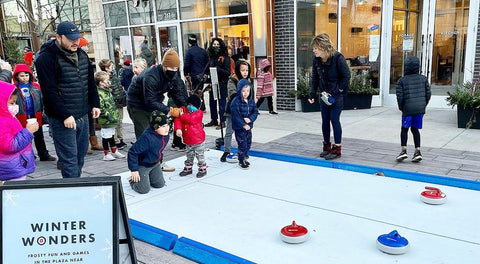
    PolyGlide Pro Curling Rink

    6. Get Curling!

    Ice skating is not the only activity you can do on the ice.

    Games like curling are excellent party games.

    With curling, you slide large granite (or plastic) 'stones' along the ice to a target area resembling a bullseye.

    The goal is to place as many stones in the center of this area, called the 'house,' while your opponent attempts to do the same, potentially blocking or knocking your stones out of the house. 

    Curling is a great game to spice up any Winterfest-themed party or introduce others to a cool winter sport.

    You can rent curling rinks or invest in your own for future winter events. 

    obstacle course

    7. Obstacle Course Challenge

    What's your agility on the ice?

    Test your partygoers' ice skating skills with a safe but challenging obstacle course.

    Use cones, chairs, hockey sticks, and other props for participants to slalom at their own pace. 

    You can give prizes to the person who completes the course the fastest or to those who complete the course without knocking over any obstacles. 

    Obstacle courses work well on both natural and synthetic ice rinks, with synthetic ice available for skates and sock skating, 

     ice skate cake

    How to Create Lasting Memories

    The best ice skating party ideas need many ways to make it as memorable as possible.

    Creating the right theme is not enough. It should combine thoughtful planning and personal touches that resonate with guests.

    To ensure an unforgettable experience for everyone:

    • Think out of the box with synthetic ice: Why not set up your own backyard rink? You can use synthetic ice at your home or rented space to make the ice skating party an outdoor affair. Synthetic ice connects like puzzle pieces, allowing you to create a rink in the size and shape of your choosing.
    • Consider decor and Photo Booths: All participants will want to take pictures and keep memories of an unforgettable ice skating party. Consider renting a photo booth and setting up a backdrop to take amazing pictures. Based on the theme you've chosen (superhero, for instance), you can have additional props like signs and masks to drive the theme home.
    • Themed foods and drinks: Make drinks, snacks, and cakes to mimic your theme. Hot drinks and s'mores, for instance, work well in Winterfest themes. 
    • Themed parting gifts: Provide guests with personalized party favors like custom-designed skateguards or themed keychains. 
    • Get on social media: Create a unique hashtag for everyone to share on their Instagram stories, Reels, or TikTok posts. This is a great way to have partygoers connect through these shared memories on social media. 

    There's no limit to the decorations, food, music, and other themes to make your ice skating party idea the best, most memorable experience for you and your guests. 

     Nothing Cold About this Party!

    These are just some of the ice skating party ideas available.

    Choose the best one based on your audience, age group, and overall goals.

    It's a great opportunity to introduce ice skating to those who've never skated.

    More importantly, it's a great way to transport guests to a magical experience on the ice. 

    Setting up a party of this magnitude takes work, but the results are worth it.

    Whether you're setting this party up for kids, your friends, or a work event, it's a great way to create long-lasting memories. 


    The Birthplace of Ice Hockey: When and Where did it happen?

    the birthplace of hockey

    Ice hockey, as we know it today, was born in Canada during the 19th century, with the first organized game officially recorded in Montreal in 1875. 

    This moment marks the recognized starting point of modern ice hockey, combining earlier stick-and-ball games with new rules to form the sport we follow now.

    While versions of hockey-like games existed elsewhere, Canada played a pivotal role in shaping and formalizing the game.

    This emergence was not sudden but rather the result of evolving local traditions and influences from various sports such as lacrosse and field hockey.


    Learn to Play Ice Hockey at Home with PolyGlide Synthetic Ice


    The establishment of formal rules in the late 1870s helped transition ice hockey from an informal winter pastime to a competitive sport with growing popularity across North America and eventually worldwide.

    Key Takeaways

    • Modern ice hockey began in Montreal in 1875 with the first organized game.
    • The sport developed from earlier traditional games and influences.
    • Formal rules helped transform hockey into an internationally followed sport.
    Players in vintage ice hockey uniforms playing on an outdoor snowy ice rink surrounded by pine trees and a wooden clubhouse.

    The Contenders: Where Was Ice Hockey Born?

    The origins of ice hockey involve multiple locations and influences, each with claims supported by historical documents or cultural ties.

    Early adaptations of stick-and-ball games, formalized play in urban centers, and European traditions all contribute to the story of the sport’s birth.

    Windsor, Nova Scotia: Early Claims

    Windsor, Nova Scotia, often surfaces in discussions as a possible birthplace of hockey.

    It is here that one of the earliest recorded instances of a hockey-like game on ice occurred.

    Some accounts note that by the early 1800s, students and locals played stick-and-ball games adapted for frozen ponds.

    Significantly, Windsor is credited with hosting one of the first documented organized games, bolstered by records from the Society for International Hockey Research (SIHR).

    The community's version included formal rules and a growing competitive spirit.

    This early adaptation laid the groundwork but lacked formal recognition beyond the region at the time.

    Montreal and the First Indoor Game

    Montreal claims a pivotal role due to its association with the development of modern ice hockey rules.

    The first recorded indoor hockey game took place in 1875 at the Victoria Skating Rink, organized by students from McGill University.

    This game introduced a flat puck-replacing the earlier frozen cowhide ball, and new standardized rules, differentiating it from other stick-and-ball sports.

    Montreal’s influence spread rapidly across Canada and into the United States, emphasizing formal competition and organization.

    Montreal became a hub for the sport’s growth, hosting some of the earliest leagues and widely recognized advancements in playing style and governance.

    European Influences on Ice Hockey

    Ice hockey’s roots also trace back to European stick-and-ball games such as bandy, shinty, and hurling, which were popular in Britain and Ireland.

    These games incorporated elements such as stick handling and team play, which would later evolve into the modern game of ice hockey.

    When immigrants brought these sports to Canada, they adapted them to colder climates and frozen surfaces.

    The North American sport of lacrosse also played a role in shaping hockey’s pace and physicality.

    This blend of European sports provided a historical and cultural framework that Canadian players then modified for ice and new competition formats.

    Debate and Modern Consensus

    The debate over hockey’s birthplace centers primarily on Windsor, Nova Scotia, and Montreal, Quebec.

    Windsor supports early informal play and the first rules, while Montreal claims to have established the first organized indoor game and rule standardization.

    Today, most historians agree that Canada is the birthplace of ice hockey, with its origins tied to the early games in Nova Scotia and the innovations in Quebec.

    Kingston, Ontario, also occasionally appears in debates due to local leagues and contributions.

    In summary, Canada’s provinces played complementary roles: Nova Scotia provided foundational informal play and early rules, while Montreal formalized those rules and popularized indoor competition.

    This dual heritage underpins the sport’s recognized origin.

    Men playing ice hockey on an outdoor rink

    Key Dates: When Did Ice Hockey Emerge?

    Ice hockey’s development spans several key moments in the 19th century.

    Its origins lie in early stick-and-ball games, which gradually evolved into a distinct sport with clear rules and organized play, particularly in Canada.

    Early 19th Century Ice Games

    In the early 1800s, various winter games played on ice shared similarities with modern ice hockey.

    These included adaptations of field sports, such as bandyshinty, and hurling, which were brought from Britain and Ireland.

    These games involved sticks and balls on frozen surfaces but lacked standardized rules.

    Canada's cold climate provided the perfect setting for these activities to transition into a more formalized sport.

    Students at King’s College (now McGill University) were instrumental in adapting these games to ice, emphasizing speed and skill.

    These informal matches set the stage for ice hockey’s structured growth later in the century.

    The 1875 Montreal Indoor Match

    One of the most significant milestones in ice hockey’s history was the first recorded indoor game, played on March 3, 1875, in Montreal.

    This match is widely recognized as the birth of organized ice hockey.

    James Creighton, a key figure in ice hockey history, helped organize this game at the Victoria Skating Rink.

    The event featured fixed rules and a puck, marking a pivotal change from earlier outdoor games. 

    This game’s occurrence in Montreal anchored the city’s role as the sport’s birthplace.

    Adoption of Ice Hockey by Canadian Institutions

    Following the 1875 game, Canadian institutions played a pivotal role in formalizing and disseminating ice hockey.

    McGill University published one of the first sets of official ice hockey rules in 1877, which standardized gameplay and equipment.

    The sport quickly gained popularity in universities and local clubs, including teams that would later evolve into professional organizations, such as the Montreal Canadiens.

    These early institutions laid the groundwork for the development of ice hockey, establishing leagues and organizing championships, thereby setting the framework for modern ice hockey in Canada and internationally.

    Indigenous Roots and Local Traditions

    Indigenous people playing an early form of ice hockey

    The origins of ice hockey involve a blend of Indigenous practices and early settler influences.

    These shaped key elements, such as gameplay, equipment, and cultural significance, would eventually inform the sport’s development in Canada.

    Mi’kmaq Contributions

    The Mi’kmaq people played a crucial role in the early forms of ice hockey.

     In the late 1600s, they were observed playing a stick-and-ball game called "ricket" on ice in Nova Scotia.

    This game involved using carved wooden pucks, often made from cherrywood, which influenced the design of equipment in later hockey.

    Their version emphasized skill, speed, and teamwork, traits that remain central to hockey today.

    The Mi’kmaq also spread the game to surrounding communities, helping it evolve through their traditions. 

    Their impact is recognized as foundational within the broader history of Canadian culture and sport.

    Hurley and Toadijik

    Hurley and Toadijik were terms used to describe ball-and-stick games played on ice by various Indigenous groups.

    These games varied slightly by region but shared common features like stick handling and goals, which mirror modern hockey.

    Thomas Chandler Haliburton, a 19th-century Canadian writer, documented such games, noting their popularity among Indigenous youth.

    These local adaptations illustrate how different communities contributed distinct rules and styles, providing a rich pool of traditions from which the organized game could draw.

    The Role of British Soldiers

    British soldiers stationed in Canada during the 19th century are credited with adapting Indigenous games into the more formalized sport of ice hockey.

    They borrowed concepts from local stick-and-ball activities and combined them with elements of field hockey and lacrosse, which were familiar in Britain.

    Montreal, with a strong military presence, became a key site for this transformation.

    The British influence helped introduce standardized rules and equipment, enabling the organization of matches as early as 1875.

    This melding of Indigenous practices and British structure was essential in shaping the modern sport’s early framework.

    Split scene showing early stick-and-ball game on a frozen pond

    Evolution of the Game: From Stick-and-Ball to Modern Hockey

    Ice hockey developed through the blending of various stick-and-ball games brought by European immigrants and adapted by Canadians.

    Over time, changes in equipment and playing surfaces shaped the sport into the fast-paced hockey we recognize today.

    Influence of Scottish Shinty and Irish Hurling

    We trace part of ice hockey’s origins to Scottish shinty and Irish hurling, traditional stick-and-ball games with long histories.

    Both sports involve players using curved sticks to strike a ball, emphasizing skillful stick-handling and ball control.

    Irish immigrants brought hurling influences to North America, contributing techniques and stick designs.

    Scottish settlers introduced shinty, which shares similarities with field hockey. 

    These games laid the groundwork for hockey sticks and the style of play on ice, emphasizing agility and precise stick handling.

    These early games also influenced the structure of team play and informal rules that local communities adapted for frozen ponds and outdoor rinks.

    Transition from Field Hockey to Ice Hockey

    Field hockey, played on grass, was another key precursor to ice hockey.

    As settlers in colder climates faced frozen lakes and rivers, they adapted the basic rules and equipment of field hockey to the ice by using skates.

    The use of metal skates allowed players to move swiftly while wielding hockey sticks.

    Early versions of ice hockey used a ball, but the slippery surface and colder temperatures necessitated modifications.

    We see the gradual shift from playing with a ball to introducing a puck better suited for ice.

    Early ice hockey games had uneven regulations before formal rules emerged in 19th-century Canada, particularly in Montreal. 

    This transition marked the birth of a distinct winter sport adapted to the local environment.

    The Introduction of the Puck

    The replacement of the ball with a puck was crucial in shaping the modern game of ice hockey.

    The first recorded use of a puck occurred in 1875 during a game in Montreal, where frozen pieces of a field hockey ball were used.

    Unlike a ball, the flat puck slides smoothly across ice, reducing unpredictable bounces and allowing more controlled play.

    This change also influenced the design of hockey sticks toward more specialized curves to handle the puck with precision.

    The puck’s introduction standardized gameplay and helped differentiate ice hockey from its predecessors, which featured sticks and balls.

    Along with improvements in hockey equipment, like better skates and protective gear, the puck pushed the game towards speed, skill, and its current form.

    A group of vintage ice hockey players on a frozen outdoor rink

    Codifying Ice Hockey: Rules and Early Organizations

    The transformation of ice hockey from informal pond games to a structured sport involved developing clear rules and organized bodies.

    Key Canadian institutions and associations played a central role in shaping the early framework that guided the way hockey was played and governed.

    McGill University and the First Written Rules

    McGill University played a pivotal role in formalizing the game of hockey.

    In 1875, students at McGill participated in one of the first organized indoor hockey games at the Victoria Skating Rink in Montreal.

    Two years later, in 1877, they developed the first written rules, which limited teams to nine players per side and introduced clear guidelines on gameplay.

    These early rules standardized the playing field, ending the chaos typical of informal matches.

    McGill’s influence helped shape what became known as the "Canadian rules," which spread rapidly across the country and defined key aspects of the game.

    Formation of the Amateur Hockey Association of Canada

    The Amateur Hockey Association of Canada (AHAC) was established in 1886 as the first formal governing body for organized hockey.

    Its creation marked a significant step toward institutionalizing the sport in Canada. 

    The AHAC established eligibility criteria, regulated competition schedules, and organized championship contests.

    By codifying amateur status, the AHAC differentiated between recreational players and those who would later turn professional.

    It promoted fair play while fostering growing public interest in hockey, helping the sport evolve beyond a casual pastime into a respected competitive activity.

    Rise of Organized Amateur and Professional Hockey

    As hockey gained popularity, the National Hockey Association (NHA) was founded in 1909, representing a shift toward professionalized play.

    The NHA introduced several modern features we recognize today, such as numbered jerseys, penalty shots, and "on-the-fly" line changes.

    This period saw a clear division between amateur and professional hockey.

    While organizations like the AHAC continued to govern amateur leagues, the NHA and later the NHL spearheaded the growth of professional hockey. 

    These developments solidified hockey's position as both a popular national sport in Canada and an internationally recognized competition.

    NHL Growth Expansion Chart

    National and International Expansion

    Ice hockey's growth beyond its Canadian origins involved the development of structured leagues, the introduction of prestigious trophies, and the expansion of fan bases across the United States and Europe.

    These developments transformed the sport into a professional and international competition that is followed worldwide.

    Creation of the National Hockey League

    The National Hockey League (NHL) was formed in 1917 after the suspension of the National Hockey Association.

    It initially featured Canadian teams but quickly evolved into the premier professional hockey league in North America. 

    The NHL's founding teams established standards for professional play, formalized schedules, and promoted consistent rules.

    By the 1920s, the NHL had expanded into the United States, introducing franchises such as the Boston Bruins in 1924, the first American NHL team.

    This move helped popularize hockey south of the border and increased commercial opportunities. 

    The league's ongoing growth has made it the highest level of professional ice hockey in the world.

    Stanley Cup and Key Milestones

    The Stanley Cup, originally donated in 1892, became the NHL’s championship trophy after the league gained control in 1926.

    It symbolizes the highest achievement in ice hockey and represents a long history of competition.

    Major milestones include the NHL's absorption of rival leagues, such as the Pacific Coast Hockey Association (PCHA), which introduced new rules, including blue lines and the forward pass.

    These innovations helped evolve the game into the faster and more strategic sport we recognize today.

    Spread to the United States and Europe

    Ice hockey expanded rapidly beyond Canada through both professional leagues and international competitions.

    In the U.S., the NHL's American teams helped establish strong regional fan bases and grassroots programs.

    In Europe, the International Ice Hockey Federation (IIHF), founded in 1908, facilitated organized competition and standardized rules for international play.

    Olympic hockey, introduced in 1920, and events like the World Cup of Hockey further promoted global participation. 

    These platforms allowed hockey to thrive across continents, attracting millions of players and fans worldwide.

    womens hockey player

    Cultural Impact and Modern Legacy

    Ice hockey's origins have deeply influenced its role in shaping cultural identities, sports traditions, and the development of professional leagues worldwide.

    The sport continues to evolve, reflecting societal changes while maintaining strong ties to its historical roots.

    Hockey’s Role in Canadian Identity

    Hockey is a defining element of Canadian culture. It reflects both regional pride and national unity.

    The sport is intricately tied to Canada’s history, symbolizing resilience and community spirit.

    Rinks in small towns and big cities alike serve as social hubs.

    The game fosters a shared cultural experience from childhood through adulthood.

    We see hockey as more than a sport, it's part of who we are. 

    It brings Canadians together across language and geography, celebrated in schools, local leagues, and major professional events.

    Influence on Popular Culture and the Winter Olympics

    Hockey’s impact extends beyond the rink into popular culture.

    Movies, music, and literature have incorporated hockey themes, thereby embedding the sport in the public consciousness.

    The Winter Olympics spotlight hockey as a key event, showcasing national pride and fierce competition among countries.

    Canada’s multiple gold medals have reinforced the sport’s stature internationally.

    The Olympics also contributed to the globalization of hockey, inspiring countries to develop their own programs and leagues, thereby increasing the sport’s worldwide reach and diversity.

    The Growth of Women’s and Professional Hockey

    Women’s hockey has seen significant growth, gaining mainstream attention through international competitions and professional leagues.

    The sport provides new opportunities for female athletes and expands hockey’s audience.

    Professional hockey, highlighted by leagues such as the NHL, has undergone significant evolution since the "Original Six" era.

    Players like Wayne Gretzky and Sidney Crosby have become global icons, shaping the modern image of the game and inspiring future generations.

    Advances in training, ice rink facilities, and media coverage have professionalized the sport, making it accessible and appealing to millions worldwide.

    Notable Teams and Legendary Players

    The "Original Six" teams, Boston Bruins, Chicago Blackhawks, Detroit Red Wings, Montreal Canadiens, New York Rangers, and Toronto Maple Leafs, set the foundation for the NHL’s popularity in North America.

    Players such as Wayne Gretzky, known as "The Great One," have left a lasting legacy on the sport with their skill and records.

    Sidney Crosby represents the new era of competitive excellence.

    These teams and stars define hockey’s competitive spirit and cultivate a dedicated fan base that spans generations. Their stories continue to inspire players and fans alike.

    Frequently Asked Questions

    We explore specific dates, locations, and individuals associated with the origins of ice hockey.

    We also discuss the game’s development and Canada's historical role in it. 

    Additionally, we touch on the early roots of field hockey.

    What is the origin date of the sport of ice hockey?

    Organized ice hockey is widely recognized to have started in 1875.

    The first recorded game took place in Montreal on March 3, 1875.

    Which country is recognized as the birthplace of ice hockey?

    Canada is often regarded as the birthplace of modern ice hockey.

    The sport developed there through adaptations of earlier stick-and-ball games.

    Who are the key figures credited with formalizing the rules of ice hockey?

    Early contributors include Canadian players and organizers in Montreal.

    The first published set of official rules appeared in the Montreal Gazette in 1877.

    How has the game of ice hockey evolved since its inception?

    Ice hockey began as a simple, informal game on frozen ponds.

    It grew into an organized sport with formal leagues, including the NHL, and spread globally.

    What role does Canada play in the history of ice hockey?

    Canada not only originated the organized form of ice hockey but also shaped its rules and competitive structure.

    It remains central to the sport’s culture and professional leagues.

    What are the origins and early developments of field hockey?

    Field hockey evolved from older stick-and-ball games in Britain and Ireland.

    These early forms influenced ice hockey’s stick handling and gameplay elements.