
Sharpen Your Ice Skates Like a Pro: Best Step-by-Step Guide

Quick Answer: To sharpen ice skates, you grind a concave hollow into the blade's bottom edge using either a professional grinding machine, a flat file with a jig, or an automatic home sharpener like the Sparx... choosing a depth (radius of hollow) matched to your skating style and body weight.
Recreational skaters should sharpen every 20–40 hours of ice time; competitive skaters every 8–15 hours.
Professional sharpening at a skate shop costs $8–$20 per session; home machines like the Sparx run $499–$599 upfront but pay off quickly for households with multiple skaters.
Last updated: April 2026
Knowing how to sharpen ice skates is one of the most practical skills a skater can have... yet most people have never done it themselves.
Sharp blades give you grip, speed, and control on the ice.
Dull blades slow you down, make it harder to turn, and increase your risk of falling.
Whether you skate recreationally, play hockey, or train as a figure skater, understanding blade sharpening will help you perform at your best and get more out of every dollar you spend on equipment.
In this guide, we'll explain exactly what sharpening does, how to know when it's time, how to choose the right hollow, and how to do it yourself or work effectively with a skate shop.

Skate Better at Home With PolyGlide Ice
What Does Sharpening Actually Do to an Ice Skate Blade?
Unlike a kitchen knife, which is sharpened to a single flat edge, an ice skate blade is ground to create a concave groove along its bottom... called the radius of hollow.
This hollow creates two edges: an inside edge and an outside edge.
Those two edges are what dig into the ice, providing the grip needed for turns, stops, spins, and jumps.
Without a proper hollow, the blade drags across the ice rather than biting into it.
To understand sharpening, it helps to know the key parts of an ice skate blade:
- Toe and heel plates (figure and dance skates): Spade-shaped metal plates that attach to the boot with screws.
- Stanchion: The metal bridge that connects the blade to the plates.
- Footplate and blade holder (hockey skates): Hard plastic components that hold the blade and allow it to be ejected and swapped.
- Blade (Runner): The long steel strip that contacts the ice. Figure skating runners are slightly longer than hockey blades; thickness ranges from 3mm to 5mm.
- Toe picks: The serrated front edge found on figure and dance skates, used for jumps and spins.
- Edges: The two sides of the blade... inside and outside... each used for different skating moves.
- Radius of Hollow: The concave groove ground between the two edges. A deeper hollow grips more but sacrifices speed; a shallower hollow is faster but grips less.
- Blade Radius: The longitudinal curve of the entire blade from toe to heel. A longer radius keeps more of the blade in contact with the ice at once.

Sharpening also corrects nicks, scratches, rust, and burring... raised bumps along the vertical edges caused by contact with hard surfaces or aggressive skating moves like hockey stops.
The sharper your blades and the more precise your hollow, the better they perform... creating the thin film of water necessary for gliding, stopping, and turning.

How Do You Know When Your Skates Need Sharpening?
The clearest sign that your skates need sharpening is a loss of grip... you feel your edges sliding out during crossovers, turns, or stops.
You may also notice reduced speed, a rough sensation when gliding, or more effort needed to push off.
Visible rust, burrs, or nicks on the blade are also definitive signs.
As a general rule, use these time-on-ice benchmarks:
- Recreational skaters: every 20–40 hours of ice time
- Competitive hockey players: every 8–15 hours of ice time
- Competitive figure skaters: every 8–15 hours, or after any session involving heavy jump training
- Deeper hollows wear faster - a 3/8" hollow may need refreshing more often than a 5/8"
A good habit is to track blade wear and log your ice time so you're never caught off guard before a game or competition.
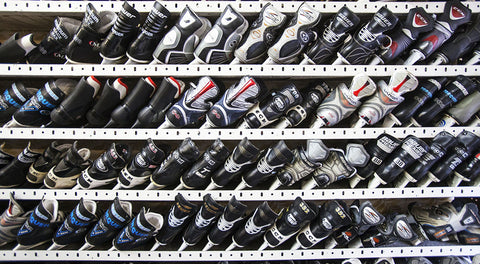
Rental skates are a perfect example of what happens when sharpening is neglected... they're notoriously dull, which is why rental skating feels so much harder than skating on your own well-maintained skates.
What Radius of Hollow Should You Use?
The radius of hollow (ROH) is measured in fractions of an inch and refers to the depth of the concave groove ground into the blade.
A smaller number (e.g., 3/8") means a deeper, narrower hollow with more grip but less glide.
A larger number (e.g., 1") means a shallower, flatter hollow with more speed but less bite.

Use this reference guide to find the right starting point for your skater type:
- Beginner (recreational): 1/2" - balanced grip and glide, forgiving for new skaters
- Competitive figure skater: 3/8"–7/16" - deep grip for precise edge control
- Hockey forward: 3/8"–1/2" - aggressive grip for quick stops and crossovers
- Youth skater (under 100 lbs): 5/8"–3/4" - lighter skaters need more hollow to grip effectively
- Heavier adult skater: 3/8"–7/16" - more weight means more pressure on the blade; a deeper hollow compensates
- Synthetic ice skater: 7/8"–1" - synthetic surfaces provide more resistance than real ice, so a shallower hollow reduces drag
Finding your ideal hollow is a process of trial and feedback... what works on cold outdoor ice may feel sluggish on a warm indoor rink.
Start with the recommended range for your skater type and adjust by 1/16" increments based on how the skates feel.
You can read more about hollow selection and ice skate blade anatomy in our detailed blade guide.
How Do You Sharpen Ice Skates at Home?

Home sharpening gives you full control over timing and hollow selection... no waiting for a shop, no trusting a stranger with your blades.
The trade-off is cost and a learning curve.
If you have multiple skaters in your household or on your team, the investment pays for itself quickly.
Pros of Sharpening at Home
- You control when and how you sharpen your skates
- Best option if no quality skate shop is nearby
- Eliminates inconsistent results from rotating shop staff
- You learn a skill that gives you deeper insight into blade performance
- Long-term cost savings for multi-skater households
Cons of Sharpening at Home
- Quality sharpening machines are a significant upfront cost
- Not cost-effective if only one person skates occasionally
- Mistakes will happen during the learning phase
Step 1: Gather Your Tools
Before you begin, collect everything you'll need based on your chosen method.
At minimum, you'll want a Torx wrench, flat honing stone, deburring stone, lubricant, a clean cloth, and grit paper for rust removal.
Add safety glasses... metal filings are no fun in the eyes.
Step 2: Remove the Blades and Clean
Use a Torx wrench to detach the blades from the boot, keeping the screws organized for each boot separately.
This lets you work with the blade cleanly, without the boot getting in the way.
Wipe down both the blade and boot with a microfiber cloth.
Note: If you're using a Sparx home machine, blade removal is not required... the full boot mounts directly to the machine.
Step 3: Inspect the Blade for Damage

Look for chips, cracks, rust, burring, or misaligned edges before you start grinding.
Minor chips can often be corrected during resharpening; deeper damage may require a professional repair.
For rust, use grit paper to scrub it away, then run a honing stone along the blade profile to deburr any raised bumps.
Hold the blade to a light source to check for edge misalignment... one edge shorter than the other is a common issue after heavy use.
Step 4: Sharpen the Blade
Choose the sharpening method that matches your tools and experience level.

Method A: Professional Grinding Machine (Wissota / Blademaster)
A bench-mounted grinding machine is the gold standard for consistent, precise sharpening.
Brands like Wissota and Blademaster are trusted by shops and serious home sharpeners alike.
- Install your chosen radius grinding wheel per the machine's instructions.
- Set the diamond dresser arm and pass it over the wheel 4–5 times to condition the surface.
- Mount one skate on the blade-holder with the blade facing the wheel.
- Pass the skate against the wheel's spin 4–6 times with light, even pressure.
- Turn off the machine, wipe the blade, and inspect for imperfections.
- Repeat 1–2 passes as needed; use a cross-grinding technique (wheel perpendicular to blade) to remove stubborn imperfections.
Method B: Flat File and Jig (Manual)
Manual sharpening with a flat file and jig takes patience but builds the deepest understanding of blade geometry.
You'll need a sharpening jig, flat honing stone, needle file (pre-measured to your hollow), and lubricant.
- Load the blade or boot into the jig upside down with edges facing you.
- Apply lubricant to the honing stone and pass it heel-to-toe about 15 times, then toe-to-heel. Wipe residue periodically. The grinding sound will soften to a smooth hum when the edge is ready.
- Take the needle file and pass it heel-to-toe to cut the hollow. This takes several minutes and some trial and error.
- Remove the blade, clean off any burrs with a cloth and honing stone, and inspect the edge.
Expect to practice many times before achieving consistent results... this method rewards patience.
Method C: Automatic Home Machine (Sparx)

The Sparx Skate Sharpener and similar home machines (Wissota Portable, CAG One) take the guesswork out of the process.
The Sparx retails for $499–$599... a significant upfront cost that becomes economical with three or more skaters in the household.
These machines typically support hollows from 3/8" to 5/8" via interchangeable grinding rings.
- Install the desired grinding ring for your hollow.
- Mount the full boot (no blade removal needed) into the jig mechanism.
- Turn on the machine... it passes the grinding ring over the blade automatically and alerts you when complete.
- Inspect the blade afterward and use a honing stone to remove any burns or burrs left by the grinding ring.
For households with multiple skaters, a Sparx home machine often pays for itself within the first year compared to recurring shop visits.
Step 5: Reassemble and Test
If you removed the blades, reattach them with the original screws and confirm proper alignment across the full radius of the blade.
Test your skates on the ice as soon as possible... performance feedback is the best diagnostic tool.
If something feels off, go back to the machine and fine-tune; small adjustments in hollow make a noticeable difference.
Should You Sharpen at a Skate Shop Instead?

Most recreational and competitive skaters get their blades done at a skate shop... and for good reason.
Professional sharpening typically costs $8–$20 per session, depending on your location and the shop.
At that price point, shop sharpening is excellent value... as long as you're working with a skilled technician.
Pros of Using a Skate Shop
- Years of experience and calibrated machines on your side
- No large upfront equipment investment
- Professionals can achieve a wider range of hollows than most home machines allow
- Takes the hassle out of learning the craft yourself
Cons of Using a Skate Shop
- You must schedule visits and wait your turn
- Cost adds up over a full season... $8–$20 × many sessions is real money
- Quality varies; newer technicians may not deliver the hollow you asked for
- Some skate shops are far from home, limiting convenience
If you choose a shop, bring your skates clean and ready, and always communicate your hollow preference clearly before they touch your blades.
What Should You Tell Your Skate Technician?
Walking into a skate shop without a clear request is the most common sharpening mistake skaters make.
If you hand over your boots without direction, most shops will default to a 1/2"–5/8" hollow... sometimes called a "house cut"... which is a middle-of-the-road setting that works for most casual skaters but isn't optimized for anyone.
Before you hand over your skates, be ready to tell your technician:
- Your skating style - recreational, hockey (position), figure skating (level)
- Your preferred hollow - use the reference chart in H2 #3 above as your starting point
- Your approximate body weight - this significantly affects the right hollow for grip and glide
- Any known issues - nicks, misalignment, rust, or a hollow that felt wrong last time
Tell the skate technician your skating style, preferred hollow, and body weight... never let them guess.
When you get your skates back, check both edges for evenness, look for burrs or nicks, and get on the ice as soon as possible to verify performance.
Provide feedback on your next visit... experienced technicians appreciate it and will fine-tune their work accordingly.
You can also read our full guide on how often ice skates should be sharpened to build a consistent maintenance schedule.
Does Synthetic Ice Change How You Should Sharpen Your Skates?

Yes... skating on synthetic ice does affect how your blades should be sharpened, and many skaters don't realize it until their edges are wearing unevenly.
Synthetic ice is made from High-Density Polyethylene (HDPE) panels infused with a built-in lubricant that allows the blade to glide without refrigeration.
Because HDPE is harder and creates more friction than real ice, blades can experience accelerated edge wear... especially on the lower portion of the hollow.
For synthetic ice skating, use a shallower hollow of 7/8"–1".
A shallower hollow reduces drag on the polymer surface while still maintaining enough edge to push and turn effectively.
The good news: high-quality synthetic ice panels like PolyGlide Ice are engineered to minimize blade wear, so you won't need to sharpen significantly more often than you would on real ice with normal home use.
If you're practicing shooting, stickhandling, or edge work on a home synthetic ice surface, keep an eye on your hollows and plan for one additional sharpening per season compared to your normal real-ice schedule.
Frequently Asked Questions About Ice Skate Sharpening

-
How often should you sharpen your ice skates?
Your sharpening frequency depends on how many hours you skate and at what intensity.
Recreational skaters should plan on sharpening every 20–40 hours of ice time.
Competitive hockey players and figure skaters should sharpen every 8–15 hours, or sooner if they notice grip loss or edge damage.
Deeper hollows wear faster and may require more frequent visits to the sharpener.
-
How much does skate sharpening cost?
A professional sharpening at a skate shop typically costs $8–$20 per pair, depending on location and shop.
Home machines like the Sparx Skate Sharpener cost $499–$599 upfront, but each sharpening then costs only the price of a grinding ring (rings sharpen approximately 40–60 pairs before replacement).
For a household with two or more regular skaters, a home machine typically pays for itself within a season or two.
-
What hollow is best for a beginner?
Most beginners do well with a 1/2" hollow, which provides a balanced mix of grip and glide without being too aggressive.
Very light beginners (children under 100 lbs) may benefit from a 5/8"–3/4" hollow to get enough bite on the ice at lighter weight.
Avoid very deep hollows (3/8" or less) until you have enough skating skill to manage the increased grip... they can actually make it harder to glide smoothly for new skaters.
-
How long do ice skate blades last?
A quality pair of ice skate blades typically lasts 5–10 years with proper care, or approximately 50–100 sharpenings.
Blade lifespan depends on factors including skater weight, ice conditions, blade steel quality, and aftercare habits.
Walking on hard surfaces with bare blades, skating on rough or dirty ice, and infrequent drying all accelerate blade wear.
When one edge wears significantly more than the other... as tracked by tools like the wear score generator... it may be time to consider replacement.
-
Will continuous sharpening shorten the life of my blades?
Not meaningfully, as long as you're sharpening on schedule rather than over-sharpening.
Blades are designed to be sharpened repeatedly... each session removes only a tiny amount of steel.
The cumulative effect across 50–100 sharpenings over 5–10 years is what eventually thins the blade to the point of replacement, not any single session.
Irregular or incorrect sharpening (wrong angle, uneven passes) causes more damage than consistent, proper sharpening.
-
Do handheld skate sharpeners work?
Handheld tools... including honing stones, the Y-stick, and the Edge Again Skate Sharpener... are useful for freshening up an edge before a session or touching up a burr at the rink.
They are not substitutes for a full sharpening... they don't grind the hollow; they only smooth the existing edges.
Think of them as the equivalent of stropping a knife... maintenance between sharpenings, not a replacement for the real thing.
-
What happens if you don't sharpen your ice skates?
As the blade dulls, you'll progressively lose grip, speed, and control on the ice.
Turns become harder to execute, crossovers feel unstable, and stopping requires more effort.
For hockey players, dull skates directly reduce sprint speed and explosive acceleration.
For figure skaters, dull edges make jumps and landings significantly more dangerous.
Beyond performance, skating on severely dull blades increases fall risk and can cause compensatory movement patterns that lead to muscle strain over time.
-
Do skates on synthetic ice wear differently than on real ice?
Yes... Synthetic ice creates slightly more surface friction than real ice, which can cause faster hollow wear, particularly for skaters doing intensive edge work or stops.
However, modern synthetic ice panels engineered with built-in lubricants... like PolyGlide Ice... significantly reduce this effect compared to older, unlubricated tiles.
If you skate primarily on synthetic ice, use a shallower hollow (7/8"–1") and check your edges every 15–20 hours rather than waiting for performance to degrade noticeably.
The blades themselves do not wear out faster... just the hollow may need refreshing slightly more often during heavy training periods.
Ready to Skate Sharper?
Sharpening your ice skates is both a science and a skill... one that rewards attention to detail and consistent practice.
Whether you choose to sharpen at home with an automatic machine or rely on a trusted skate shop, knowing the right hollow for your skating style and body weight puts you miles ahead of skaters who just hand their blades over without direction.
Use the hollow reference guide above as your starting point, track your ice hours, and don't be afraid to experiment... small adjustments lead to big performance gains.
Track your blade wear and know when it's time to sharpen with our blade wear score generator.
And if you're training at home, synthetic ice panels from PolyGlide Ice are engineered to be edge-friendly... so your blades stay in top condition longer between sharpenings.
Skate Better at Home With PolyGlide Ice
Related Posts

What's the Best Synthetic Ice for Figure Skating (2026)

How Much Does a Synthetic Ice Rink Cost? Best Guide for Buyers